Hey there, if you’ve ever shopped around for a precision surface grinder, you’ve probably run into a bunch of terms that make you go “wait, what’s that actually mean?” — and one of the most confusing ones is “cutting speed.” A lot of folks new to machining (or even some seasoned ones, let’s be real) mix it up with spindle speed, feed rate, or just guess at what number they need. As someone who’s spent the last 12 years selling precision surface grinders and walking customers through setting them up right, I’m here to break this down like we’re chatting over a beer after a long day in the shop, not reading a college textbook. Precision Surface Grinder
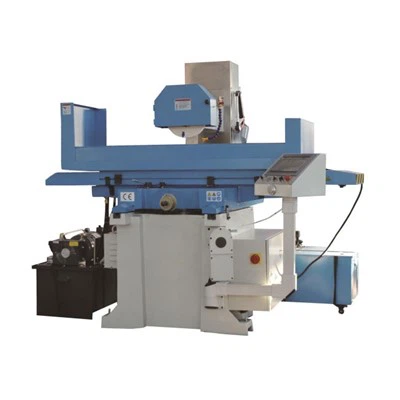
First off, let’s get the basics straight: cutting speed (we usually just call it Vc in the shop, because why type out three extra letters when you don’t have to) is the speed at which the edge of your grinding wheel is moving relative to the workpiece. It’s not how fast the spindle is spinning — that’s spindle speed (rpm). Those are related, but only if you plug in the wheel diameter, right? Think of it like riding a bike: your legs spin the crank (that’s rpm), but how fast you move forward depends on the size of the wheel (grinding wheel diameter) on your bike. A bigger wheel means you go farther with each spin, same as a bigger grinding wheel means the edge moves faster per spindle rotation.
I see this mix-up all the time when a customer calls in panicking because their grinder’s manual says Vc should be 1,800 feet per minute (fpm) and their old machine only hits 1,200 rpm. Relax — you just gotta do the simple math to convert, and that’s where the confusion clears up. The formula is Vc = (π × wheel diameter × rpm) / 12. Wait, why divide by 12? Because diameter is in inches, and we want Vc in feet per minute, so you convert inches to feet. Let’s test that with an example: if you’ve got a 10-inch diameter grinding wheel spinning at 2,290 rpm, plug that in: (3.14 × 10 × 2,290) /12. That works out to about 1,800 fpm — exactly where you need to be. Easy, right? I keep a little cheat sheet taped to my workbench for when I’m on the phone with customers, no need to pull out a calculator every time.
Now, why does this even matter? Because Vc is the biggest factor in how your grind turns out — not just how fast the job gets done. Too low, and you get what we call “wheel loading” — tiny bits of metal get stuck in the gaps between the grinding grit, so the wheel stops cutting, it just rubs, and you burn the workpiece. Too high, and the grit dulls fast, you get crazy chatter marks on the part, and the wheel can even shatter — not something you want on your watch list, trust me. I once had a customer who cranked his grinder to double the recommended Vc to finish a job fast, and the wheel exploded mid-grind. No one got hurt, but he had to replace the machine’s guard, and the part was ruined. Worth rushing? Definitely not.
So what’s the actual sweet spot for Vc on a precision surface grinder? Let’s split this up because it’s not one-size-fits-all, which is a myth a lot of cheaper grinder brands push to make their machines sound “one size fits all.” First, the type of grinding wheel matters. Aluminum oxide wheels (the most common for steel, stainless, and general metals) usually run at 1,200 to 2,400 fpm. CBN wheels (those for hard metals like tool steel, carbide) are higher — 4,000 to 6,000 fpm, because those grits are way tougher. Diamond wheels? Even higher, 5,000 to 10,000 fpm, perfect for super hard stuff like ceramics or carbide.
Then there’s the workpiece material. Soft, ductile metals like aluminum? You need a lower Vc, around 1,000 to 1,500 fpm. Otherwise, you’ll load the wheel so bad you could almost use it as a sanding block. For mild steel, that’s 1,500 to 2,000 fpm. Hardened tool steel? Push it up to 2,000 to 2,500, because you need that speed to cut through the tough surface without burning it. And if you’re grinding something super brittle, like ceramic? Keep it on the lower end of the range — too high, and the part will crack before you finish. Don’t ask how I know that… let’s just say I’ve got a box of ruined ceramic inserts in my garage as a reminder.
Wait, also — don’t sleep on your machine’s capabilities. Not all precision surface grinders are built the same. Some cheap import grinders will top out at 2,000 rpm, so if you need a Vc of 1,800 fpm with an 8-inch wheel, that works (plug the numbers in: (3.14×8×2000)/12 = ~1,675 fpm, close enough). But if you’re running a 12-inch wheel and need 1,800 fpm? You need a grinder that can hit 2,860 rpm, which a lot of entry-level grinders can’t do. That’s why when customers ask me “which grinder should I get?”, I don’t just look at price — I look at the rpm range, because that’s what lets them hit their target Vc for their specific jobs. A lot of new guys skip this and end up stuck with a machine that can’t do the work they need down the line.
Another thing: dresser speed. Wait, hold on, that’s related too, I swear. When you dress your grinding wheel to keep it sharp and true, you should set your dresser’s cutting speed to be a fraction of your wheel’s Vc — like 10 to 15% of Vc. If your wheel is at 1,800 fpm, your dresser should be around 180 to 270 fpm. Most dressers are hand-cranked, so you adjust how fast you push them across the wheel to hit that. If you run the dresser too fast, you’ll dull the wheel grit too much before you even start grinding. Too slow, and you’ll overwork the grit and cause burn. I see so many guys ignore this part, and they wonder why their surface finish is garbage 10 minutes into a job. It all ties back to cutting speed, that’s the through-line here.
Now, let’s talk about common mistakes I see all the time. First, confusing cutting speed with feed rate. Feed rate is how fast you move the table (and the workpiece) across the wheel. That’s a separate setting, totally — Vc is about the wheel edge, feed rate is how much material you take off per pass. They both matter, but they’re not the same. Second, not accounting for wheel wear. As the wheel gets smaller (it wears down every time you use it), the diameter changes, so your Vc drops automatically. That means you gotta adjust the rpm as the wheel wears to keep Vc where you need it. A lot of guys set the rpm once when they put a new wheel on and never touch it, and by the end of the wheel’s life, they’re running at 1,000 fpm when they should be at 1,800 — hence the loading and burn. Third, forgetting the coolant. Coolant doesn’t just keep the machine from overheating — it keeps the cutting zone cool, which lets you run at higher Vc without burning the part. If you’re running dry, you gotta drop your Vc by 20 or 30%, easy. I had a job last year where a customer was grinding stainless steel dry at 2,000 fpm, and every part came out burned. We hooked up the coolant, dropped Vc to 1,600, and boom — perfect parts.
What about for specialty jobs? Like, if you’re doing ultra-precision grinding for aerospace parts or medical implants? You might run Vc a bit lower, around 1,500 to 1,800, because surface finish is everything. No one wants a medical implant that’s got chatter marks, right? And if you’re doing high-volume production, you might nudge Vc up a bit (within safe limits) to get the job done faster, but you gotta keep an eye on wheel wear so you don’t have to dress it every 10 parts.
Here’s the thing: at the end of the day, cutting speed isn’t some mysterious number only engineers get to know. It’s just a setting that makes your grinder work right, your parts come out good, and you don’t waste time or money on ruined workpieces or broken wheels. As a precision surface grinder supplier, my whole job isn’t just to sell a machine — it’s to make sure my customers know how to use it right. I get calls every week from guys who bought a grinder online, got it set up, and are messing up because they didn’t understand Vc, and we walk them through it over the phone. That’s way more important to me than making a quick sale.
If you’re in the market for a precision surface grinder, don’t just ask about price — ask about the rpm range, how it handles different wheel sizes, and if the manual has clear guidelines for Vc by material and wheel type. A good grinder will have that, and the seller will take the time to explain it to you. If a vendor tries to brush off your questions about cutting speed, that’s a red flag — chances are, their grinders aren’t built for consistent, quality work, and you’ll be stuck troubleshooting for years.

At the end of the day, getting cutting speed right is half the battle for good surface grinding. It’s not rocket science, it’s just paying attention to how your wheel, your workpiece, and your machine all work together. If you’re ready to invest in a grinder that’s built to hit those Vc numbers consistently, no guesswork involved, or you just have more questions about setting up your current machine, don’t hesitate to reach out and start the conversation. We’re here to help you get your jobs done right, every time.
Horizontal Surface Grinder References
Krar, S. M., & Check, A. F. (2018). Technology of Machine Tools (7th ed.). McGraw-Hill Education.
Oliver, W. R. (2020). Grinding Technology: Theory and Applications in Machining of Advanced Materials. Society of Manufacturing Engineers.
Tulsiyan, J. K., et al. (2019). Effect of Cutting Parameters on Surface Finish in Precision Surface Grinding. International Journal of Machining and Machinability of Materials, 21(3), 245-262.
Wuxi Mingxu Machinery Equipment Co., Ltd.
As one of the most professional precision surface grinder manufacturers and suppliers in China, we’re featured by quality products and good price. Please rest assured to buy the best precision surface grinder for sale here from our factory. Also, custom service is available.
Address: No. 5-5 Jinke Wealth Plaza, Changjiang North Road, Xinwu District, Wuxi City, Jiangsu Province
E-mail: yingyingmxjd@163.com
WebSite: https://www.mingxu-china.com/
