If you’ve ever stood beside a manual surface grinder in my shop, watching an operator lean in, adjust a handwheel, and work a tool across a piece of metal until its surface is so flat it could act as a reference for other parts, you’ve probably wondered what makes that precision possible. Most people focus on the grinding wheel or the operator’s steady hand, but if you ask anyone who’s spent decades setting up or repairing these machines, they’ll tell you the real backbone of a manual surface grinder is something you might not even notice at first glance: the guide rails. As someone who’s been supplying manual surface grinders for over 18 years, I’ve seen firsthand how a set of well-built guide rails can turn a beginner’s tentative cut into a consistent, quality part—and how worn or poorly designed rails can ruin even the most skilled operator’s work. Today, I want to break down exactly what role these seemingly simple metal strips play, why they matter more than most people realize, and what that means for anyone working with these machines. Manual Surface Grinder
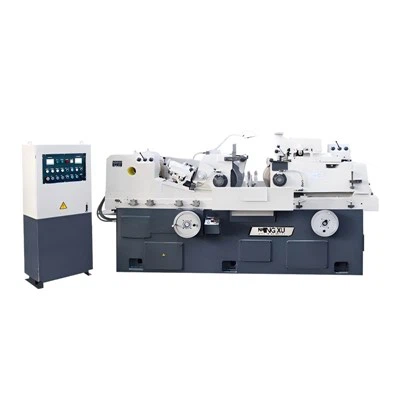
Let’s start with the basics to set the stage. A manual surface grinder is built for one core job: producing a perfectly flat, smooth surface on a workpiece, usually metal, for things like mold bases, mechanical parts, or tooling components. Unlike CNC grinders that do all the adjustments automatically, manual surface grinders rely entirely on the operator to control three key movements: the cross traverse (left and right across the table), the longitudinal traverse (back and forth along the table’s length), and the vertical feed (adjusting how close the grinding wheel gets to the workpiece). Every one of these movements depends entirely on guide rails to keep motion straight, consistent, and free of slop. Slop, for those new to machining, is that unwanted give or play between moving parts—like how a loose door handle wiggles instead of turning smoothly. Even a tiny bit of slop in a manual grinder’s rails can lead to inconsistent cuts, wavy surfaces, or parts that are slightly out of tolerance, which is a big deal when you’re making parts that have to fit together with near-micrometer precision.
First, guide rails are the foundation of linear motion. Every moving part on a manual surface grinder rides on these rails: the table that holds the workpiece, the saddle that moves the table side to side, and the head that holds the grinding wheel all glide along carefully machined guide rails. If you think of the grinder as a body, the rails are the skeleton—they determine how all the other parts move in relation to each other. I remember when a new customer once brought in a grinder they’d bought used, complaining that their workpieces kept coming out with a slight taper along the length. We took off the table’s saddle and found that the guide rails on the machine’s base had a spot where they’d worn down unevenly over years of use. Instead of the saddle moving straight along the rail’s entire length, it would dip a fraction of a millimeter in that worn spot, making the table tilt just enough to leave a taper on every part. Replacing those rails fixed the issue immediately—and that’s the thing about guide rails: they work quietly in the background, but their condition directly dictates every single cut a machine makes.
Next, guide rails ensure uniform load distribution. When an operator is grinding a heavy workpiece, say a 50-pound steel block, that weight isn’t just sitting on the table—it’s spread across the contact points between the table’s bearings and the guide rails. Good guide rails are machined to a perfectly flat, parallel profile, so the load is spread evenly along the entire length of the rail instead of concentrating in one spot. If the rails are worn, or poorly aligned, that weight will press harder on certain sections, which can cause the table to bind slightly in some areas or move unevenly. I’ve seen this play out on jobs where an operator is doing a finish cut, where they’re only removing a few thousandths of an inch of material with each pass. Even a tiny uneven load on the rails will make the table speed up or slow down fractionally as it moves, leading to surface marks that you can see under a magnifying glass—enough to make a part unfit for its intended use, like a medical device component or a mold for plastic parts.
Then there’s vibration control, which is make-or-break for surface finish. Vibration is the enemy of manual surface grinding. It comes from a few places: the spinning grinding wheel, uneven workpiece material, or even the operator’s hand adjusting the feed. Guide rails act as a dampener for that vibration, because their rigid, machined surface keeps moving parts stable. If rails are loose or worn, vibration can travel up through the saddle and table to the workpiece, leaving tiny, unwanted lines on the ground surface. I always tell new operators that if they stand next to a running manual grinder and can feel a faint buzz through the base of the machine, the first thing they should check is the guide rail alignment. More often than not, a quick adjustment of the gibs (the small metal plates that fit against the rails to control clearance) or a light lubrication of the rail surface will cut that vibration almost entirely, resulting in a much smoother finish.
Wait, let’s talk about gibs too, because they’re inseparable from guide rails in a manual surface grinder. Gibs are thin, adjustable strips of metal that run along the sides of the saddle or table, pressing against the guide rails to control the gap between the moving part and the rail. There’s a fine balance here: too tight, and the table will bind, making it hard for the operator to move smoothly. Too loose, and you get that slop I mentioned earlier, leading to inaccuracies. A lot of new operators don’t realize that adjusting the gibs is a daily task for many manual grinder users—before a shift starts, they’ll run the table back and forth a few times, adjust the gib screws until the table glides easily with just a light hand, but no give. That adjustment is only possible because the guide rails provide a consistent, flat surface for the gibs to push against. Without properly machined rails, you can’t get that balance right, no matter how carefully you adjust the gibs.
Now, not all guide rails are created equal, and that’s where my team and I put a lot of focus when we build the manual surface grinders we supply. Most entry-level grinders use cast iron guide rails, which are affordable and hold a good surface finish, but they require regular lubrication to prevent rust and wear. Higher-end models use hardened steel guide rails, which are much more resistant to wear, so they last longer even with heavy daily use. We also machine our rails to a tolerance of less than 0.0005 inches over their entire length— that’s thinner than a human hair, for context. That kind of precision means that even when the machine is running for 10 hours a day, the movement remains straight and consistent. I’ve had customers tell me they’ve been using our grinders for 15 years, and the original guide rails still don’t need replacement, even though they’re doing high-volume production work. That’s the kind of reliability we prioritize, because we know our customers rely on these machines to get parts out on time, every time.
Another key point: guide rails are critical for repeatability, which is huge for production work. If an operator can set the depth of the cut on the vertical feed, and know that every time they move the table back and forth along the rails, it will follow the exact same path, they can replicate a part 100 times, 1,000 times, with the exact same flatness and dimensions. Without that, every part would be slightly different, which is a non-starter for any business that’s making parts for assembly lines or custom projects where consistency is key. I had a customer a few years ago who was making small hydraulic valves for tractors—each valve required six perfectly flat surfaces, and if even one was off, the valve would leak. They’d been using a grinder with worn rails, and they were getting a 15% reject rate. After replacing the guide rails with our hardened steel set, their reject rate dropped to less than 1%, and they were able to increase their production by 20% because they spent less time reworking bad parts. That’s the impact good guide rails have on a shop’s bottom line.
Let’s address a common misconception too: some people think that with CNC technology, guide rails are less important, but that’s not true for manual surface grinders. The whole point of a manual grinder is that the operator is in control, and that control depends entirely on the rail system. CNC grinders have linear ways and encoders to track movement, but manual grinders rely on the operator’s hand to feel the resistance of the table moving along the rails. If the rails are worn, that resistance isn’t consistent—sometimes it’s smooth, sometimes it’s slightly bumpy—so the operator can’t get that subtle feedback they need to make a finish cut. A good manual grinder’s guide rails let an experienced operator “feel” the cut, adjusting the feed slightly as they go to get a surface that’s perfect, not just within tolerance. That’s the art of manual surface grinding, and it’s only possible because of the guide rails.
Now, what about maintenance? Guide rails don’t last forever, but with simple care, they can last for decades. The biggest enemy of guide rails is lack of lubrication and contamination—grinding swarf (the tiny metal chips from cutting), coolant, and dust can get into the gap between the rails and the saddle, causing scratches and wear. That’s why we always recommend that operators clean the guide rails with a soft cloth after every use, apply a light, non-corrosive lubricant, and check the gib adjustment weekly. Even small swarf particles left on the rails can leave a scratch that will show up on every workpiece until the rail is resurfaced. We also offer guide rail resurfacing as a service, because we know that even with good care, rails can wear over time, and resurfacing them is much cheaper than replacing the entire machine.
I want to circle back to why this matters for anyone who’s in the market for a manual surface grinder. When you’re comparing machines, it’s easy to look at the grinding wheel size, the table size, or the price, but the guide rails are the hidden feature that will make or break your experience. A cheap grinder with poorly machined guide rails might work for a small hobby project, but if you’re running a shop doing production work, or making precision parts that need to hold tight tolerances, you need a machine with high-quality, properly machined guide rails. That’s why we invest so much in the manufacturing process for our grinders—we don’t cut corners on the guide rails, because we know that’s where our customers will see the difference in their work.

At the end of the day, guide rails are the quiet workhorses of the manual surface grinder. They don’t spin or grind, they don’t adjust automatically, but they make every other part of the machine’s function possible. They ensure straight movement, even loads, vibration control, repeatability, and the all-important feedback that an operator needs to make a perfect cut. If you’re tired of dealing with inconsistent parts, high reject rates, or grinders that wear out after just a few years, the first thing you should look at is the guide rail system. If you’d like to learn more about how our manual surface grinders are built with precision guide rails, or discuss your specific grinding needs, feel free to reach out. We’ve helped shops of all sizes, from small custom machine shops to large manufacturing facilities, get the precision and reliability they need from their surface grinders. We look forward to helping you find the right solution for your work.
Precision Centerless Grinder References
- Industrial Maintenance & Plant Operation. "Guide Rail Selection and Maintenance for Precision Machine Tools." 2022.
- Machining Science and Technology. "The Role of Linear Motion Components in Surface Grinding Precision." Vol. 18, No. 3, 2014.
- American Machine Tool Distributors’ Association. "Best Practices for Manual Surface Grinder Operation and Maintenance." 2021.
- Manufacturing Engineering. "Key Components of Precision Surface Grinding Machines." Vol. 152, No. 4, 2023.
Wuxi Mingxu Machinery Equipment Co., Ltd.
As one of the most professional manual surface grinder manufacturers and suppliers in China, we’re featured by quality products and good price. Please rest assured to buy the best manual surface grinder for sale here from our factory. Also, custom service is available.
Address: No. 5-5 Jinke Wealth Plaza, Changjiang North Road, Xinwu District, Wuxi City, Jiangsu Province
E-mail: yingyingmxjd@163.com
WebSite: https://www.mingxu-china.com/
